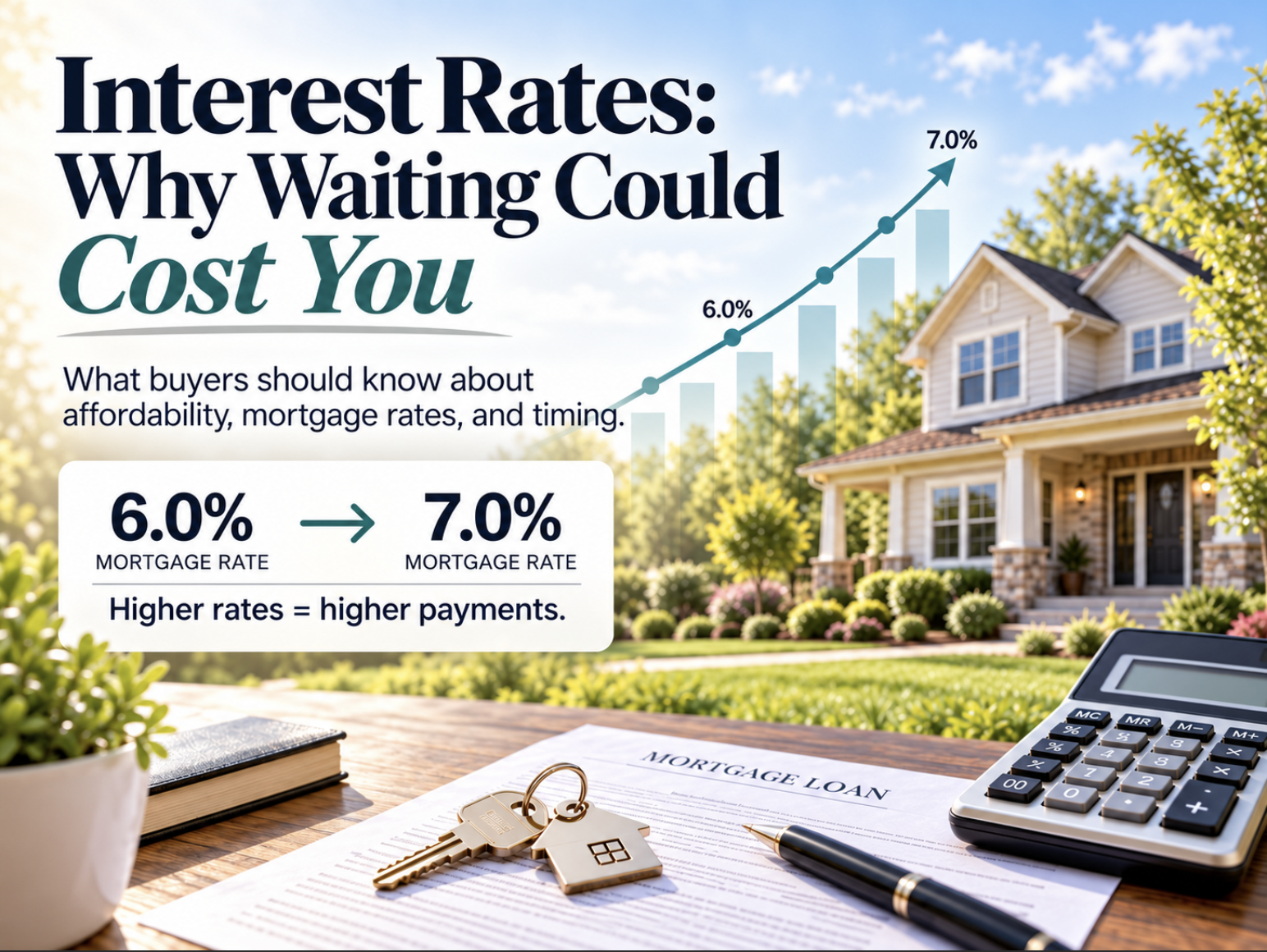
For buyers, one of the most important numbers in a home search is not simply the price of the house. It is the interest rate used to finance it. A small change in mortgage rates can change a buyer’s monthly payment, purchasing power, and ultimately the price range they can comfortably afford. That is especially important in today’s market because the latest economic outlook does not point toward a return to the unusually low mortgage rates buyers experienced during the pandemic. Instead, the evidence increasingly suggests that mortgage rates in the 6% range may be the benchmark buyers need to plan around for the foreseeable future. What Are Interest Rates Doing Now? As of August 27, 2026, Freddie Mac reported an average 30-year fixed mortgage rate of 6.66%. Just a few months earlier, the average had fallen as low as 6.23% in April and 6.43% in early July before moving back into the upper 6% range. (Freddie Mac) There are several reasons rates have faced renewed upward pressure, but inflation is a major one. The Federal Reserve's job includes keeping inflation under control. When inflation remains elevated, the Fed has less room to lower its benchmark interest rate and may need to maintain—or even increase—rates to slow economic demand. Mortgage rates do not move directly with the Federal Funds Rate, but expectations about Fed policy, inflation and longer-term Treasury yields all influence mortgage borrowing costs. The Mortgage Bankers Association recently said that inflation remains elevated and could move higher. MBA Chief Economist Mike Fratantoni noted that the Federal Reserve may be moving toward another rate-hiking cycle and said markets were beginning to anticipate a possible increase before the end of 2026. MBA's current forecast is for mortgage rates to average close to 6.5% for the foreseeable future. (MBA) Fannie Mae's August housing forecast tells a similar story. It projects the average 30-year mortgage rate at approximately 6.8% during the fourth quarter of 2026 and an average of approximately 6.7% for 2027. In other words, Fannie Mae is not projecting a meaningful retreat in rates over the next year. (Fannie Mae) Realtor.com Economic Research has also pointed to upward pressure from inflation and Federal Reserve policy. Its August analysis noted that there was relatively little downward pressure on mortgage rates and that another Fed rate increase before the end of 2026 was becoming increasingly possible if inflation remained stubborn. (Realtor) Taken together, these forecasts do not mean rates will move straight upward every week. Mortgage rates fluctuate constantly. But they do suggest that buyers should be cautious about making a housing decision based on the assumption that substantially lower rates are right around the corner. The Pandemic Rates Were the Exception Many buyers still remember mortgage rates in the 3% and 4% range and understandably hope those rates will return. But those rates occurred during an extraordinary economic period. They were driven in part by emergency monetary policies adopted during the pandemic and should not be considered the normal benchmark for today's housing market. That distinction matters. A buyer waiting for rates to return to 4% could potentially remain on the sidelines for years while home prices, rents and interest rates continue to change. Today's buyer may be better served by asking a different question: Can I comfortably afford the right home at today's price and today's interest rate? If the answer is yes, then today's market—not the pandemic market—is the appropriate benchmark. Absolutely. I’d change the table to 6.00% through 7.00% so buyers can clearly see the cumulative impact of a full one-point increase. Why One-Tenth of a Percent Matters A change of just 0.10 percentage point may sound insignificant, but over a 30-year mortgage, those small increases add up. The examples below assume 20% down and a 30-year fixed-rate mortgage. Payments shown are principal and interest only. Mortgage Rate $400,000 Home$320,000 Loan Increase From 6.00% $500,000 Home$400,000 Loan Increase From 6.00% 6.00% $1,919 — $2,398 — 6.10% $1,939 +$21 $2,424 +$26 6.20% $1,960 +$41 $2,450 +$52 6.30% $1,981 +$62 $2,476 +$78 6.40% $2,002 +$83 $2,502 +$104 6.50% $2,023 +$104 $2,528 +$130 6.60% $2,044 +$125 $2,555 +$156 6.70% $2,065 +$146 $2,581 +$183 6.80% $2,086 +$168 $2,608 +$209 6.90% $2,108 +$189 $2,634 +$236 7.00% $2,129 +$210 $2,661 +$263 Illustrative payments based on a 30-year fixed-rate mortgage with 20% down. Principal and interest only; taxes, insurance, HOA dues and other costs are not included. This actually makes the affordability point stronger. A move from 6.00% to 7.00% increases the payment by approximately $210 per month on a $400,000 home and $263 per month on a $500,000 home—without the buyer getting any more house. That is $2,520 to $3,156 more per year simply because the cost of borrowing increased. For a buyer whose comfortable housing budget is fixed, the result can be even more significant: instead of simply paying more each month, the buyer may have to lower the price of the home they can afford. That is purchasing power. Waiting for a Lower Rate Is Still a Bet There is another side of this equation that buyers sometimes overlook. Waiting for mortgage rates to fall assumes that home prices will wait for you too. They may not. A buyer might wait a year hoping to save half of a percentage point on the mortgage rate, only to discover that the property that costs $500,000 today costs more by the time that lower rate arrives. And there is no guarantee the lower rate will arrive at all. This doesn't mean everyone should rush out and purchase a home. A buyer should have stable finances, appropriate reserves and a payment that fits comfortably within the household budget. But for someone who is financially prepared and already planning to purchase, waiting solely because of interest rates may not improve the situation. Buying Now Can Also Mean Having More Choices Today's higher-rate environment has created challenges, but it has also created opportunities. Freddie Mac recently noted that more homes are coming onto the market and slower price growth in many markets is giving buyers more options and contributing to a more balanced housing market. (Freddie Mac) Buyers may encounter fewer bidding wars than they did when mortgage rates were 3%. Depending on the property and local market, that can mean more time to make a decision and potentially more opportunity to negotiate price, repairs, closing costs or other terms. If interest rates eventually decline substantially, another dynamic is also likely: more buyers may return to the market. A lower interest rate is attractive, but it becomes less advantageous if you're suddenly competing with five other buyers for the same house. Sometimes the better opportunity is not the market with the lowest interest rate. It is the market in which a buyer has the strongest combination of affordability, inventory and negotiating leverage. Ask Your Lender About Locking Your Rate For buyers already shopping for a home, another important conversation to have is about a mortgage rate lock. Mortgage rates can change daily—and sometimes during the course of a single day. A rate lock generally allows a lender to hold an agreed-upon interest rate for a specified period while the transaction moves toward closing. According to the Consumer Financial Protection Bureau, common rate-lock periods are 30, 45 or 60 days, although longer periods may be available from some lenders. (Consumer Financial Protection Bureau) This can be particularly valuable when rates appear to be trending upward. Programs vary significantly by lender, so buyers should ask: ● How early can I lock my rate? ● How long can I lock it? ● Is there a fee for a longer lock? ● What happens if my closing is delayed? ● Does the lender offer a float-down option if market rates decrease after I lock? A float-down provision, when offered, may allow a borrower to take advantage of a lower market rate after locking, subject to the lender's specific rules and costs. The CFPB specifically advises buyers to understand the lender's rate-lock policy and make sure the lock period is long enough to cover the expected closing date. (Consumer Financial Protection Bureau) That makes a strong lender relationship especially important in a changing rate environment. Buyers shouldn't simply ask, "What's your rate today?" They should ask what strategies are available to protect that rate once they are ready to move forward. The Goal Isn't to Time the Market. It's to Make a Good Decision. ● There is rarely a moment when every housing-market condition lines up perfectly. ● When rates are low, competition may be intense. ● When competition decreases, rates may be higher. ● When prices soften, financing conditions may change. ● And while buyers wait for one part of the equation to improve, another part may become less favorable. ● That is why the right time to purchase a home is ultimately determined by the buyer's circumstances. ● Maybe you've outgrown your current house. ● Maybe you're ready to downsize. ● Maybe you're relocating. ● Maybe you've been renting and are ready to begin building equity. ● Maybe the right property has finally become available. There have always been buyers and sellers in high-rate markets, low-rate markets, buyers' markets and sellers' markets. People don't stop needing homes because economic conditions aren't perfect. Today's mortgage market should be approached with clear expectations. Rates are currently in the mid-to-upper 6% range, and several respected housing economists expect them to remain there—with the possibility of additional upward pressure as policymakers continue confronting inflation. (MBA) For a qualified buyer who can comfortably afford the payment, that creates a compelling reason to act rather than wait indefinitely for a rate environment that may not materialize. Buy the home when the home, the payment and the timing are right for you. And if rates eventually move materially lower? You can talk with your lender about whether refinancing makes financial sense at that time. What you cannot do is go back and purchase today's house at today's price—or recover the purchasing power you may lose if rates continue moving higher. If you're considering buying in the next six to twelve months, now is a good time to meet with both your real estate broker and a trusted lender. Know what you can afford today, understand your rate-lock options, and be prepared to act when the right property comes along. Sources: Fannie Mae Economic & Strategic Research, August 2026 Housing Forecast; Mortgage Bankers Association economic commentary, July 2026; Freddie Mac Primary Mortgage Market Survey; Realtor.com Economic Research; Consumer Financial Protection Bureau. (Fannie Mae)
- Intrest Rates